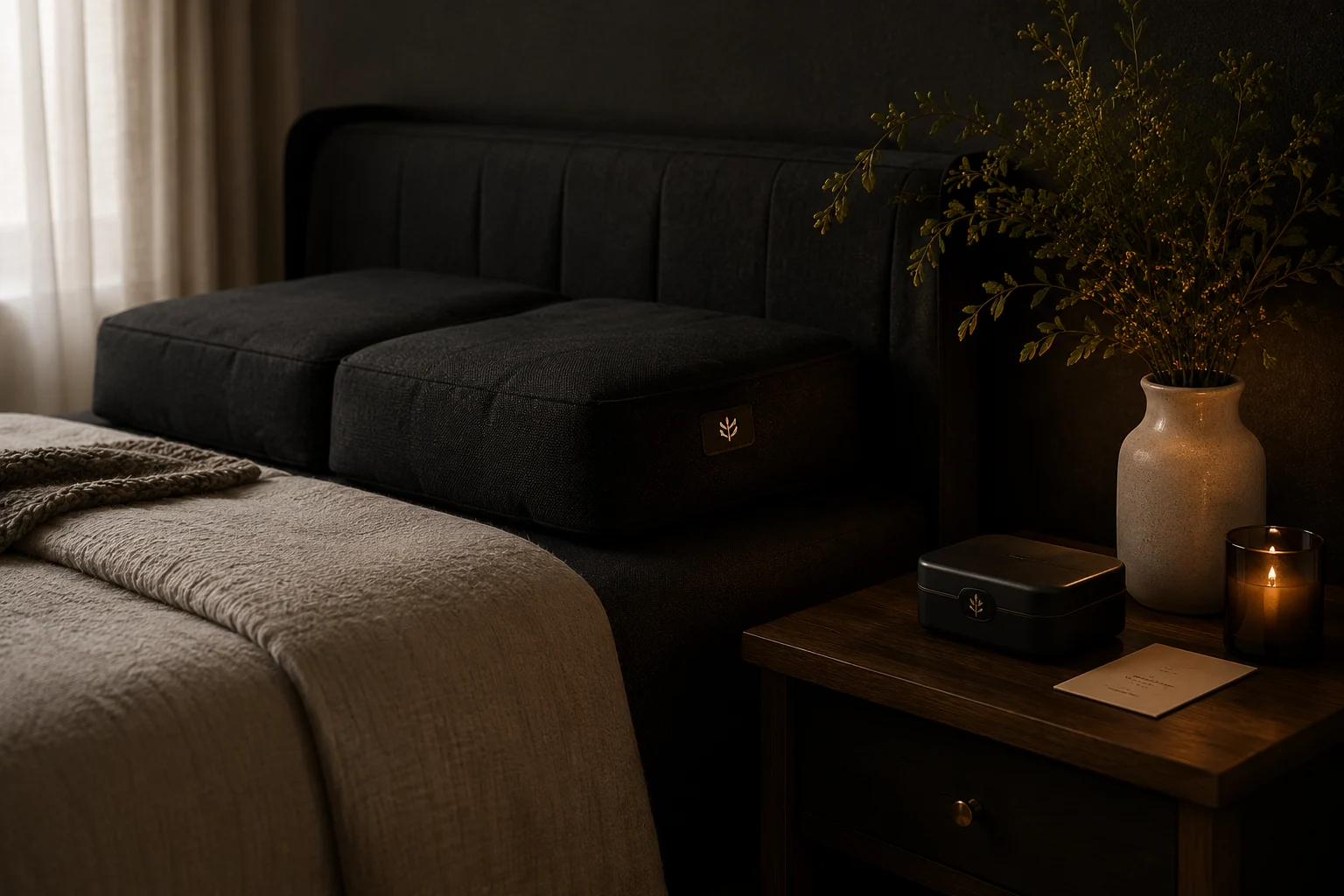
The $0 Sleep Experiment: 30 nights, no gadgets, no supplements — just the fundamentals
Reviewed by the Pausestack editorial team
Last reviewed June 23, 2026
Every recommendation is grounded in hands-on testing and published research — never in who pays us. See how we test →
Before you spend a single pound or dollar on sleep technology, run this experiment. Six free interventions, 30 nights, no gadgets, no supplements. For most women in perimenopause, the fundamentals move the needle more than any device. The tech comes after — if you still need it.
Research
Cognitive behavioural therapy for insomnia (CBT-I) — a non-pharmacological approach built on sleep hygiene and stimulus control — is consistently rated as the first-line treatment for chronic insomnia by clinical guidelines, including NICE in the UK and the American College of Physicians in the US.
Annals of Internal Medicine (2016) →Why start here
The wellness industry — including the part of it that this site covers — has a financial incentive to tell you that you need better tools. That's worth naming honestly. Most sleep problems during perimenopause have significant behavioural components: inconsistent wake times, bedroom temperatures that are too warm, evening light exposure that suppresses melatonin, and caffeine that's still active in your system at midnight.
These are free to fix. And fixing them first gives you a clean baseline. If your sleep is still poor after 30 nights of consistent fundamentals, then it makes sense to invest in a cooling mattress pad, a wearable, or a telehealth consultation. But if the fundamentals work — and they often do — you've saved yourself significant money and simplified your life.
The most powerful sleep intervention costs nothing. It's called a consistent wake time.
The six interventions
Run all six simultaneously for 30 nights. The research on each is robust. The effect compounds when they're combined.
1. Fix your wake time first
Not your bedtime — your wake time. Set an alarm for the same time every morning, including weekends, and keep it for 30 nights regardless of how late you went to sleep. This is the single most powerful sleep intervention in the clinical literature. It rebuilds your sleep drive — the accumulating pressure that makes you sleepy — which tends to erode when sleep is fragmented.
During perimenopause, hormonal fluctuations disrupt the circadian rhythm directly. A fixed wake time is one of the few behavioural levers that consistently re-anchors it.
Research
Consistent sleep and wake times strengthen the circadian signal, improving sleep quality and reducing sleep onset latency. This effect is independent of total sleep time — meaning a consistent 6.5 hours is often more restorative than an inconsistent 8.
Sleep Medicine Reviews (2022) →2. Drop your bedroom temperature
Core body temperature must fall by approximately 1°C to initiate sleep onset. During perimenopause, impaired thermoregulation — driven by declining oestrogen — makes this harder. The simplest intervention: make your room colder than you think it should be.
Target 16–19°C (60–66°F). Open a window, use a fan, or switch to a lighter duvet. If you share a bed with a partner who runs cold, a hot water bottle at their feet and a fan aimed at your side can bridge the gap. This is free, it works, and it directly addresses the thermoregulation mechanism behind night sweats.
Cooling your bedroom is the fastest single intervention for hot-flash-related waking — more immediate than any supplement or device for most women.
It requires negotiation if you share a bed, and won't help with the hormonal component of hot flashes, only the thermal environment that makes them worse.
3. Move your caffeine cutoff earlier than you think
Caffeine has a half-life of approximately 5–6 hours — longer in women taking the contraceptive pill, during pregnancy, or in individuals with certain genetic variants. A 3pm coffee still has 50% of its stimulant load active at 9pm. For many women in perimenopause, that's enough to fragment sleep.
For this experiment: no caffeine after 1pm for 30 nights. That includes tea, matcha, green tea, and dark chocolate in meaningful quantities. If you're a slow caffeine metaboliser (you can check with a genetic test, or just pay attention to how wired you feel after evening coffee), consider moving the cutoff earlier still.
4. Cut alcohol completely for 30 nights
This is the most uncomfortable recommendation on this list, and also one of the most impactful for perimenopause specifically. Alcohol initially sedates — hence the feeling that it 'helps you sleep'. But as it metabolises, it causes a rebound in arousal, fragments sleep in the second half of the night, reduces REM sleep, and directly triggers vasodilatory hot flashes in many women.
One glass of wine is enough to degrade sleep architecture measurably. This experiment asks for 30 alcohol-free nights. Not forever — just long enough to see your baseline. Many women who run this experiment find that their sleep improves more from this single change than from anything else on this list.
Research
Even moderate alcohol consumption (1–2 drinks) reduces slow-wave sleep and increases nighttime waking in the latter half of the sleep period — effects that are amplified during perimenopause due to impaired alcohol metabolism and increased sensitivity.
Alcoholism: Clinical and Experimental Research (2020) →5. Get 10 minutes of natural light before 9am
Morning light exposure is the primary zeitgeber — the environmental cue that sets your circadian clock for the day. Without it, the clock drifts. Your melatonin rise in the evening starts later. You feel alert when you should be sleepy.
For this experiment: within 30 minutes of your fixed wake time, go outside (or stand by an open window) for at least 10 minutes without sunglasses. On cloudy days the light is still sufficient — you're looking for outdoor light, not direct sun. This is free, it takes 10 minutes, and the evidence base is strong.
6. Create a 30-minute wind-down without screens
The 30 minutes before sleep should be screen-free and low-stimulation. Blue-light-blocking glasses are a partial workaround, but the problem with evening screens isn't only the light — it's the cognitive activation. Social media, news, email, and streaming create alerting responses that take time to wind down.
For this experiment: phone in another room from 9pm (or 30 minutes before your target sleep time). Read, stretch, take a bath, or do nothing. The goal is physiological de-escalation. Baths are particularly useful for perimenopause — the rise then fall in body temperature after a warm bath actively promotes sleep onset.
A warm bath 90 minutes before bed raises and then drops your core temperature — mimicking the thermal signal your body uses to initiate sleep.
How to track this without a device
Keep a pen-and-paper log for 30 nights. Each morning, spend two minutes writing: what time you woke up, roughly how long it took to fall asleep, how many times you woke up, how you feel (1–10), and whether you stuck to the six interventions the previous day.
Don't try to make this precise. The goal is to build a rough picture over 30 nights. After two weeks you'll start seeing a pattern — and you'll likely start seeing improvement before the 30 days are up.
What to do after 30 nights
If your sleep has improved significantly: you've found your baseline. Add back lifestyle elements one at a time — alcohol first, then later bedtimes, then screen evenings — and observe which ones degrade your sleep. You now have a personal map.
If your sleep has improved partially: the fundamentals are helping but something else is still disrupting you. This is when it makes sense to consider a tracker — the Oura Ring's temperature data or WHOOP's HRV patterns can help identify whether the residual disruption is hormonal, stress-related, or environmental.
If your sleep hasn't improved at all despite consistent adherence: you likely have a clinical component that free interventions won't resolve. This is when to seek a practitioner — ideally one familiar with perimenopause — rather than invest in more devices.
Our Verdict
Run the $0 experiment first. The fundamentals — consistent wake time, a cooler room, earlier caffeine cutoff, 30 alcohol-free nights, morning light, and a screen-free wind-down — address the mechanisms that perimenopause disrupts most directly.
If you still need more after 30 nights, the tech is there. But many women find they don't — and that's an expensive non-purchase they're glad they didn't make.
Compare sleep tech →You might also find useful
5 Signs Your Sleep Tracker Is Actually Helping (And 3 Signs It Isn't)
8 min read · June 6, 2026

I wore the Oura Ring every night for 60 days during perimenopause.
11 min read · May 1, 2026
WHOOP vs Oura Ring: Which sleep tracker is actually better for menopause?
12 min read · June 23, 2026