
The Pause Stack: which menopause supplements are actually worth taking (and which to skip)
Reviewed by the Pausestack editorial team
Last reviewed June 30, 2026
Every recommendation is grounded in hands-on testing and published research — never in who pays us. See how we test →
Walk into any pharmacy and you'll find a wall of pills promising to 'balance your hormones' through menopause. Almost none of them have the evidence to back that claim. But a short list of supplements genuinely earns its place during perimenopause — for your muscles, your bones, your sleep, and in some cases your hot flashes. This is the stack that survives scrutiny, and the longer list that's mostly marketing.
Read this first
No supplement replaces the two things with the strongest evidence in midlife: resistance exercise and, for many women, menopause hormone therapy (HRT). Supplements are gap-fillers that work best alongside those — not instead of a conversation with your clinician.
The Menopause Society →Three honest rules before you buy anything
First: food before pills. A supplement is, by definition, supplemental — it fills a gap that your diet and sunlight can't. If your protein is low and your veg intake is thin, fix that first; it will do more than any capsule. Second: change one thing at a time. If you start five products at once and feel better (or worse), you'll never know which one did it. Third: give each addition a real trial — most of these take six to eight weeks to show an honest effect, so resist the urge to judge them in a fortnight.
A supplement stack is a gap-filler, not a hormone replacement. Treat it like one and you'll buy less, not more.
Tier 1: the foundation (this is where the evidence actually is)
If you take nothing else, these four do the heavy lifting for the majority of women in perimenopause. They aren't exciting and they won't trend on TikTok — they're just the supplements with the most consistent research and the clearest rationale for a body losing oestrogen.
Protein (and yes, creatine)
This is the one most women under-do and the one that matters most. Falling oestrogen accelerates the loss of muscle and bone, and protein is the raw material for both. Your needs actually rise in midlife — roughly 1.0 to 1.2 grams per kilogram of bodyweight per day, higher if you're training — and most women eat well under that. A protein powder isn't a 'gym' product here; it's the easiest way to close a daily 20–40g gap. Pair it with creatine monohydrate (3–5g a day), one of the most studied supplements in existence, which helps preserve strength during caloric or hormonal dips and has an excellent safety record.
Research
Adequate protein intake combined with resistance training is repeatedly identified as a cornerstone of preserving muscle and bone mass through and after the menopause transition — the period when bone loss accelerates most sharply.
International Osteoporosis Foundation →Protein and creatine are the highest-leverage, best-evidenced, cheapest part of the entire stack — and they directly target the muscle and bone loss that defines this stage.
They do nothing for hot flashes or sleep directly, and they only work if you actually pair them with strength training — the supplement is the easy half.
Vitamin D3 (with K2)
Vitamin D deficiency is common in midlife women, and low levels undermine the calcium absorption your bones depend on right when you're most vulnerable to losing density. Most people sit somewhere between 1,000 and 2,000 IU per day, and many formulas now pair D3 with K2, which helps direct calcium toward bone rather than soft tissue. The honest move here is to test rather than guess — a simple blood level tells you whether you need a little or a lot.
Research
Vitamin D supports calcium absorption and bone maintenance, and supplementation is most clearly beneficial in people who are actually deficient — which makes a baseline blood test the smartest first step rather than a default mega-dose.
NIH Office of Dietary Supplements →Magnesium glycinate
Magnesium is the quiet workhorse of the perimenopause stack: it's involved in sleep regulation, mood, and muscle relaxation, and a meaningful share of women run low without realising it. The glycinate form is the one worth paying for — it's gentle on the gut (unlike the cheap oxide that mostly just sends you to the bathroom) and the glycine itself is mildly calming, which is why an evening dose can take the edge off restless nights.
Cheap, low-risk, and genuinely useful for the sleep disruption and muscle cramps that ramp up in perimenopause — magnesium glycinate before bed is an easy win.
The evidence is supportive rather than dramatic; it nudges sleep and mood rather than transforming them, and it won't touch hot flashes.
Omega-3 (EPA/DHA)
A combined 1–2 grams of EPA and DHA per day is one of the better-supported additions for this life stage — relevant to heart health (cardiovascular risk rises after menopause), joint comfort, mood, and the dry eyes that catch many women off guard. Look at the actual EPA/DHA numbers on the back of the bottle, not the headline 'fish oil 1000mg' on the front, because the two are often very different. A triglyceride-form fish oil or a quality algae oil if you're plant-based both work.
Research
Omega-3 fatty acids have the most consistent support for cardiovascular and triglyceride benefits, with more modest evidence for mood and joint comfort — a reasonable, low-risk foundation supplement rather than a cure-all.
Examine.com →Four supplements cover most of what perimenopause throws at your muscles, bones, heart and sleep. Everything after this is fine-tuning.
Tier 2: targeted relief for hot flashes and night sweats
This is where most 'menopause supplements' actually compete, and where you should be most sceptical of the marketing. The two ingredients with the most research behind them are black cohosh and soy isoflavones (plant compounds that weakly mimic oestrogen). The honest summary: the evidence is mixed. Some women get real relief from vasomotor symptoms; others feel nothing. Reviews of the research have repeatedly landed on 'inconsistent' rather than 'proven' — which is very different from how the bottles are sold.
Research
Systematic reviews of black cohosh and phytoestrogens for hot flashes have found inconsistent evidence overall — meaning they may help some individuals, but they shouldn't be sold as a reliable, across-the-board fix.
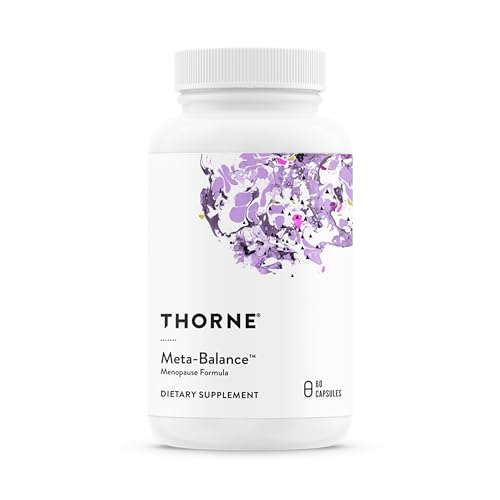
Cochrane Review →If you want to try this tier, the smart approach is a single, third-party-tested formula rather than a kitchen-sink blend — so you know exactly what you're taking and at what dose. Thorne Meta-Balance is the one we'd reach for first: it combines black cohosh and isoflavones, it's NSF Certified (a genuinely meaningful purity and label-accuracy standard), and it comes from a brand used by clinicians rather than a flashy direct-to-consumer startup. Give it the full six to eight weeks before deciding.
A clean, NSF-certified black cohosh and isoflavone formula is the most credible non-prescription route to try for hot flashes — and for the women it suits, the relief is real.
It doesn't work for everyone, takes weeks to judge, and black cohosh isn't recommended if you have liver conditions — so it's a 'try and assess', not a guarantee, and never a substitute for discussing HRT with your doctor.
Tier 3: optional, situational, or 'only if you have a reason'
These have a narrower case. Collagen has modest evidence for skin elasticity and joint comfort and is reasonable if those are your priorities — just don't expect miracles. A daily probiotic can help if your gut has become unsettled. B12 matters if you're vegetarian, vegan, or over 50 with absorption issues. Calcium is best handled through food first (dairy, tinned fish with bones, fortified plant milks, leafy greens) and only supplemented if your dietary intake is genuinely low, because there's little upside to overshooting. Ashwagandha has some support for stress and sleep, but the data is early — file it under 'experiment, don't rely on'.
What to skip (or at least be suspicious of)
Anything promising to 'balance your hormones' is using a phrase that means nothing physiologically — be wary. Proprietary 'menopause blends' and gummies that hide doses inside a trademarked mix make it impossible to know whether you're getting an effective amount of anything, and gummies in particular often carry too little active ingredient to matter. Maca, dong quai, and wild yam creams are popular but thin on convincing evidence for menopause symptoms. And mega-dose phytoestrogen stacks aren't automatically safer because they're 'natural' — more is not better here.
Worth knowing
Supplements are regulated far more loosely than medicines, so claims on the label aren't pre-approved for accuracy. Third-party certification (such as NSF or USP) is one of the few reliable signals that what's in the bottle matches what's on the label.
NIH Office of Dietary Supplements →How to build your actual stack
Start minimal. Week one: protein and creatine, because they're the foundation and the most under-used. Add vitamin D3 (ideally after a blood test) and magnesium glycinate next, then omega-3. That's the whole foundation, and for many women it's the entire stack. Only add the Tier 2 symptom support if hot flashes or night sweats are genuinely bothering you — and add it on its own, so you can actually tell whether it's working. Keep a simple note of symptoms and sleep for a few weeks; your own log is more useful than any influencer's protocol.
The honest bottom line
Most women in perimenopause need three or four supplements, not fourteen. The foundation — protein and creatine, vitamin D3, magnesium, and omega-3 — covers the muscle, bone, heart and sleep changes that define this stage, and it does so cheaply and safely. Targeted symptom relief is worth a careful try if you need it, with realistic expectations. And the whole stack works best layered on top of the unglamorous basics: strength training, a cooler bedroom, consistent sleep, and an honest conversation with your clinician about whether HRT belongs in your plan too. Buy less, choose better, and give it time.
Our Verdict
Most women in perimenopause need three or four supplements, not fourteen. Get the foundation right first — protein and creatine, vitamin D3, magnesium glycinate, and omega-3 — because that's where the real evidence sits for muscle, bone, heart and sleep.
If hot flashes and night sweats are your main complaint and you want one targeted, third-party-tested place to start, Thorne Meta-Balance — black cohosh plus isoflavones, NSF Certified — is the most credible off-the-shelf option we'd try first. Give it eight weeks, treat it as a complement to the foundation rather than a replacement, and talk to your clinician about HRT alongside it.
You might also find useful

The $0 Sleep Experiment: 30 nights, no gadgets, no supplements — just the fundamentals
10 min read · June 23, 2026

I wore the Oura Ring every night for 60 days during perimenopause.
11 min read · May 1, 2026
5 Signs Your Sleep Tracker Is Actually Helping (And 3 Signs It Isn't)
8 min read · June 6, 2026